Pendle is that rare type of token that DeFi never really knows what to do with. Not the ones with no product, not the casino plays, not the governance tokens for DAOs that haven’t shipped anything in two years.
I mean the ones that actually built something, something real, working, and genuinely hard to replicate, but got punished anyway because the broader market decided it was bored.
And if you’ve been sleeping on it, the activity in September alone should be snapping you awake right now.
Let me be clear about what I mean when I say “real.” Pendle is the world’s largest yield trading protocol. Not a contender. Not a niche player. The largest. It tokenizes future yield, splits any yield-bearing asset into a principal token (PT) and a yield token (YT) and lets traders lock in fixed rates, speculate on floating yield, or lever up on fixed APY without liquidation risk. That last part still sounds like magic to people who haven’t used it. It isn’t. It’s a protocol that has been generating real fee revenue, in real market conditions, since 2021. The 77.81% monthly move on the chart is the market finally starting to price what’s been quietly shipping underneath.
What’s Actually Driving This
Start with the freshest news, because it landed essentially this week. On September 4, Pendle announced it was live on Robinhood Chain, Robinhood Crypto’s permissionless Ethereum Layer 2 built on Arbitrum technology. The first market is sNET with a September 17, 2026 maturity, with more markets committed to follow. Robinhood Chain went public mainnet in July with Uniswap, Chainlink, and BitGo as early infrastructure partners. Pendle landing there this early, before the ecosystem has hit its first major liquidity inflection, tells you exactly where the team is placing their expansion bets.
That followed Pendle’s launch on Monad, where it opened with two AUSD pools, Agora AUSD and Upshift’s earnAUSD, both maturing October 8, 2026, with up to $100k in weekly rewards on offer. Monad’s 10,000 transactions per second and 400ms block times are built precisely for the kind of high-frequency rate-discovery action that Pendle’s AMM thrives on. The protocol showed up on Monad on day one.
Before that, Pendle went live on HyperEVM, X Layer, and Plasma, bringing the total to 14 active chains. Ethereum holds about 55% of TVL today, but the multi-chain expansion isn’t theoretical anymore. It’s deployed, live, and generating markets in real time.
The Tokenomics Fix That Most People Haven’t Fully Priced In
Here’s the part I think is still flying under the radar. Back in January 2026, Pendle published Introducing sPENDLE, and it went live the same day. This was not a minor governance tweak. It was a root-level overhaul of how the protocol distributes value.
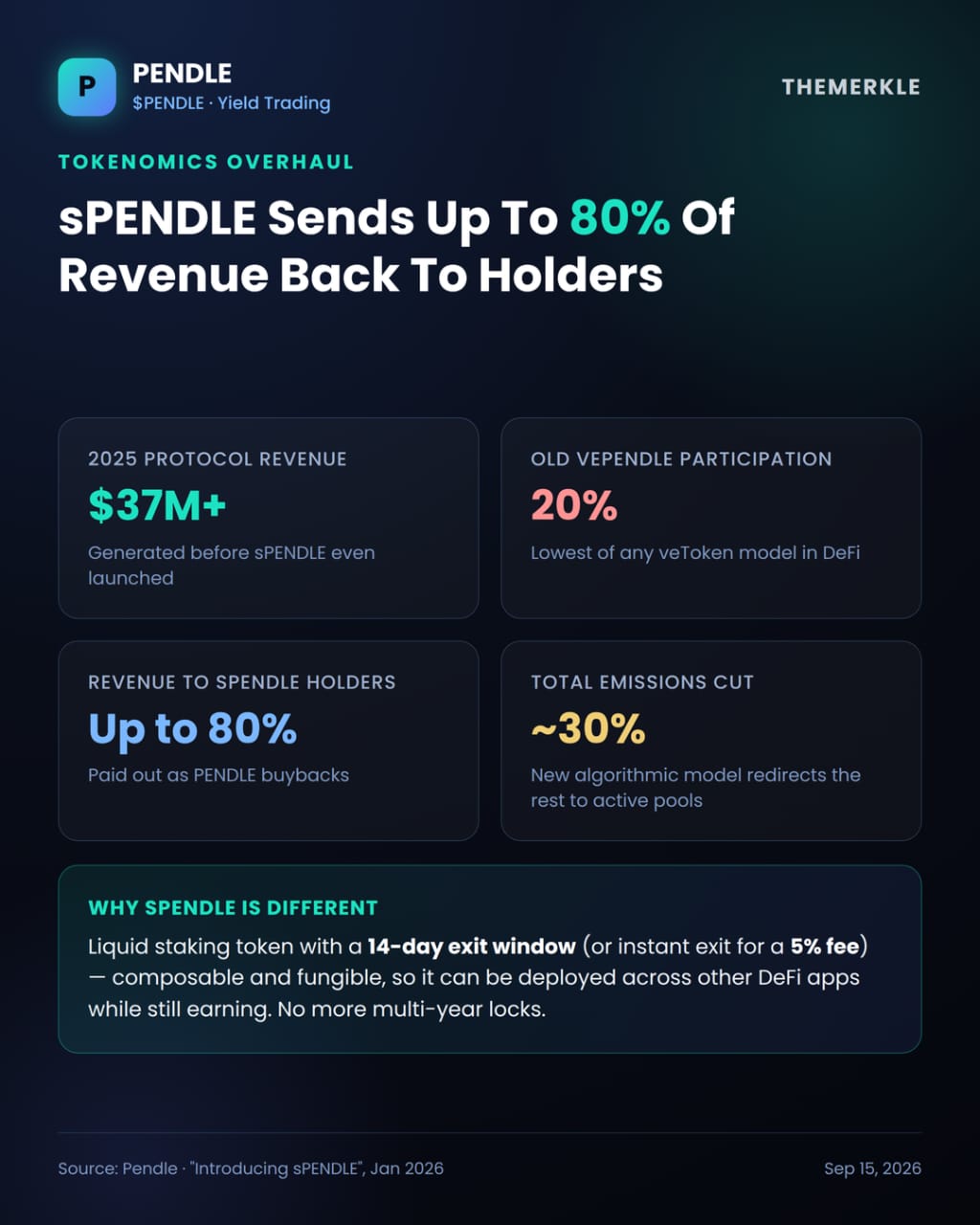
The old model, vePENDLE, required multi-year locks, concentrated rewards among a small cohort of power users, and ran emissions through a manual weekly voting process that only made sense to people who were already deeply embedded in DeFi. Despite the protocol generating over $37M in revenue in 2025, only 20% of PENDLE supply was engaged with vePENDLE, the lowest participation rate of any veToken model in the space. Most holders were getting essentially nothing back.
sPENDLE changes all of that. It’s a liquid staking token with a simple 14-day exit window (or instant exit for a 5% fee). It’s composable, fungible, deployable across other DeFi apps while still earning rewards. Up to 80% of protocol revenue now flows to active sPENDLE holders in the form of PENDLE buybacks. And the manual gauge voting is replaced by an algorithmic emission model that cuts total emissions by approximately 30% while redirecting them to pools that actually generate meaningful activity.
That’s a supply reduction and a revenue-sharing improvement landing simultaneously. Both pointing in the same direction.
Boros Is the Second Engine That’s Still Early
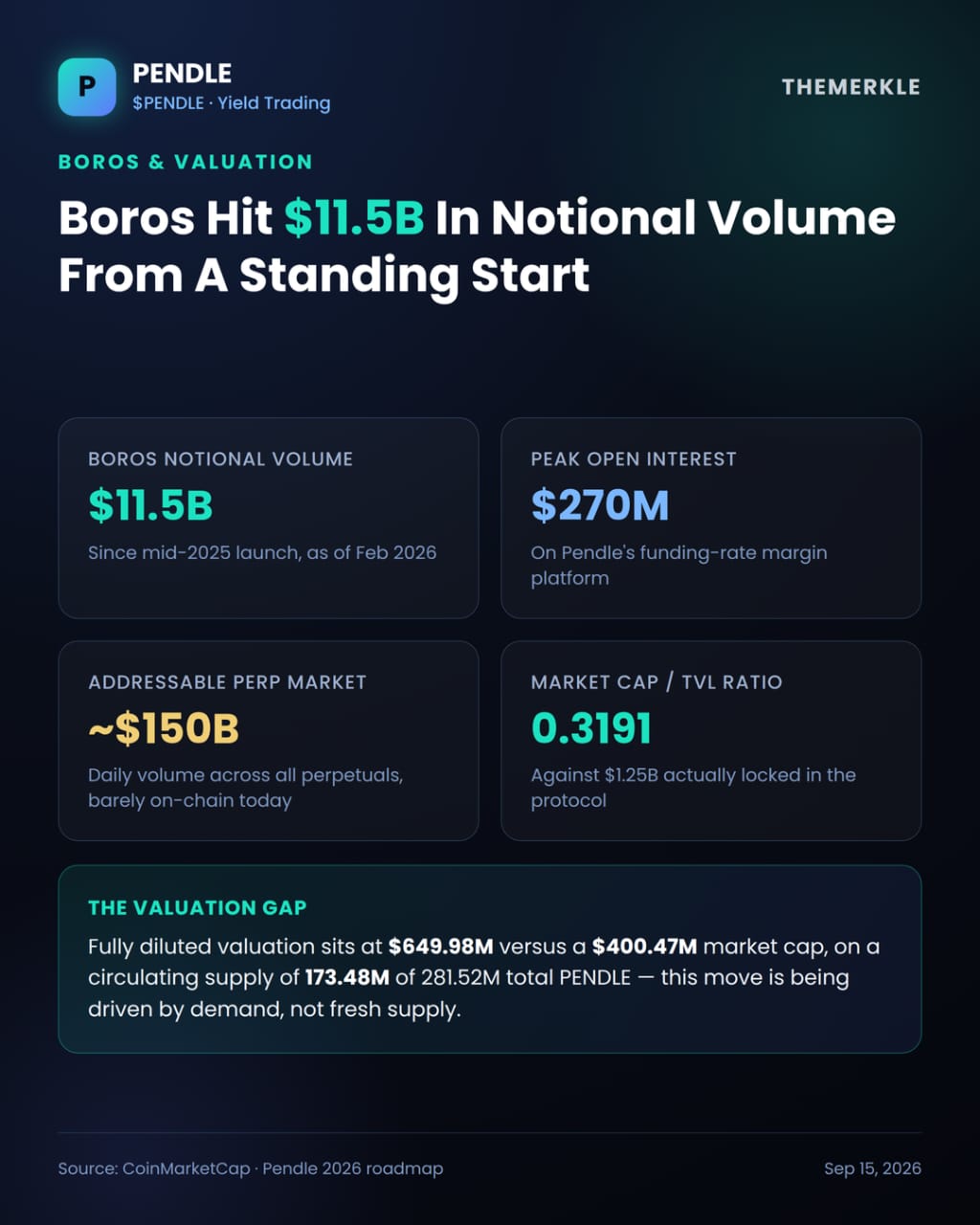
The Pendle 2026 roadmap laid out two parallel bets this year: V2 empowerment, CEX highway access, one-click leverage, auto-rolling maturities and Boros ignition. Boros is Pendle’s margin trading platform for funding rates and off-chain yields. It launched mid-2025, and by February 2026 the team reported $11.5 billion in notional trading volume and a peak open interest of $270 million from a standing start.
The total perpetuals market runs around $150 billion in daily volume. Funding rates on those perpetuals swing more violently than the underlying price itself, sometimes dramatically and until Boros, there was no clean on-chain venue to hedge, arb, or take directional exposure on those rates.
The 2026 roadmap is specifically about expanding the universe of Boros markets: more perp venues, RWA perp products (Binance and Coinbase are already racing to list equities and commodities as perpetuals), and exploiting the structural funding rate divergences that exist between exchanges simultaneously. That’s a first-mover position in a market that’s growing faster than most of DeFi and has barely been touched on-chain.
Reading the PENDLE Chart Honestly
PENDLE had a rough run from its 2025 peaks. The token hit around $6.85 in August 2025 and came all the way back to the low $2s earlier this year, a drawdown that followed the unwinding of leveraged Ethena yield strategies that had driven billions into Pendle markets. That cycle is real and it’s on the record.
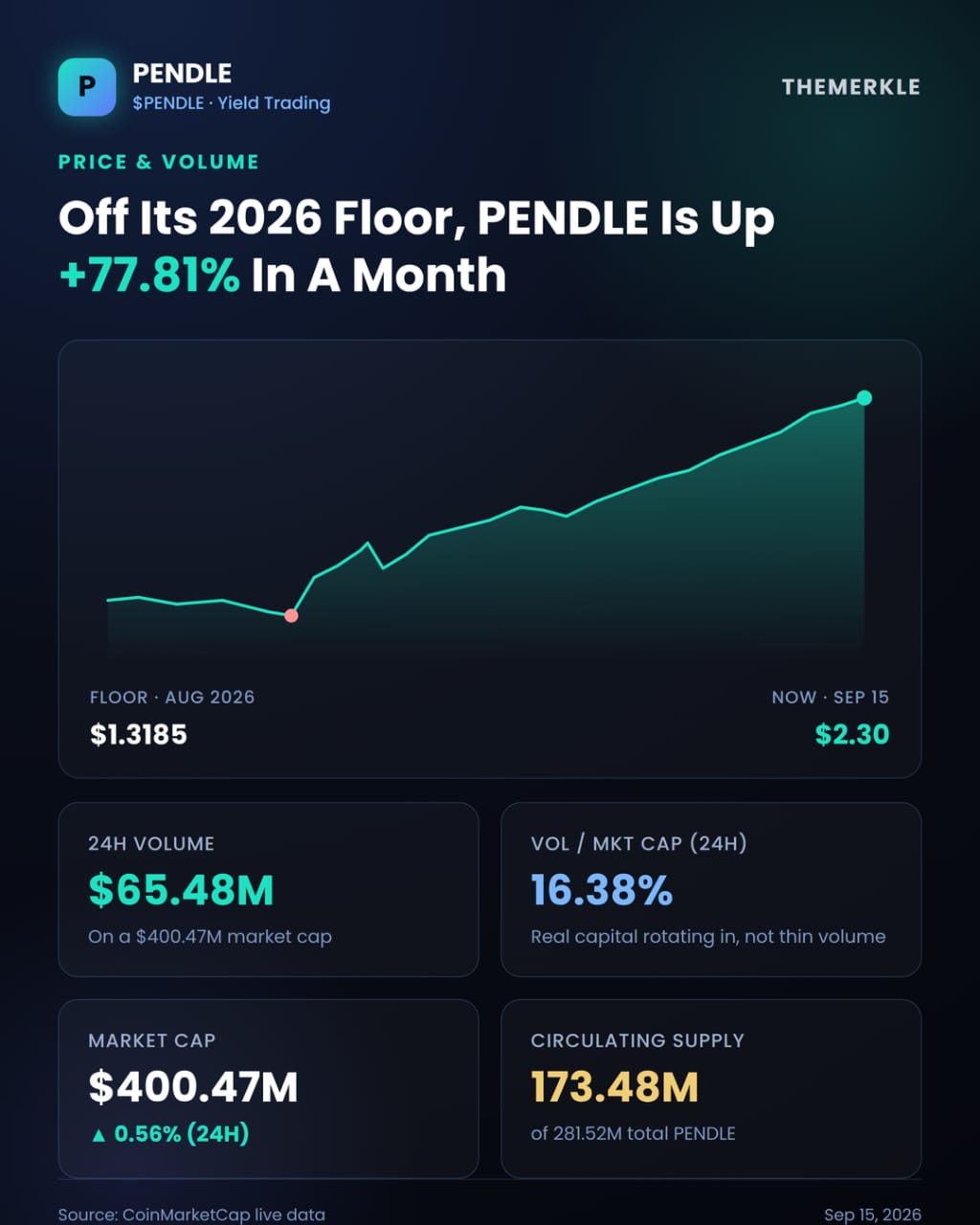
But here’s what the chart from that low looks like: $2.30 today, 77.81% up over the past month, off a floor of roughly $1.3185 visible on the 1M chart. That’s a clean, sustained move building on progressively higher volume, the 24-hour figure is $65.48M on a $400M market cap, which is a 16.38% volume-to-market-cap ratio. That’s not a token drifting higher on thin air. That’s real capital showing up.
The Market Cap/TVL ratio of 0.3191 with $1.25 billion actually locked in the protocol is one of the most undervalued readings you’ll find in this tier of DeFi. Fully diluted valuation is $649.98M. Circulating supply is 173.48M PENDLE. This move is coming from demand, not from new supply.
Where This Leaves PENDLE
I’m not going to pretend a 77% monthly move is something you chase without your eyes open. PENDLE’s revenue remains sensitive to overall yield conditions across DeFi, and a prolonged compression in rates would weigh on fee generation. That’s a real and honest risk.
But the bull case right now isn’t built on hope or narrative. It’s built on a stack of verifiable, dated, primary-source activity: a Robinhood Chain deployment live this week, a Monad expansion with live pools and $100k weekly rewards, 14 chains active and generating yield markets, a tokenomics overhaul that simultaneously broadened participation and reduced emissions, and a second trading venue in Boros operating in a structurally underserved $150B market. That’s a lot of separate, checkable things all pointing in the same direction inside a single September.
Watch Pendle’s live app at app.pendle.finance for new market deployments. The TVL and fee data over the next few weeks will tell you whether the market is finally catching up to a year’s worth of real work or just getting ahead of itself again. Either way, the receipts are on-chain. Go check them yourself.
Figures reflect live CoinMarketCap data as of the afternoon of September 15, 2026, and will move quickly given current volatility.
Disclosure: This is not trading or investment advice. Always do your research before buying any cryptocurrency or investing in any services.
Follow us on Twitter @themerklehash to stay updated with the latest Crypto, NFT, AI, Cybersecurity, and Metaverse news!