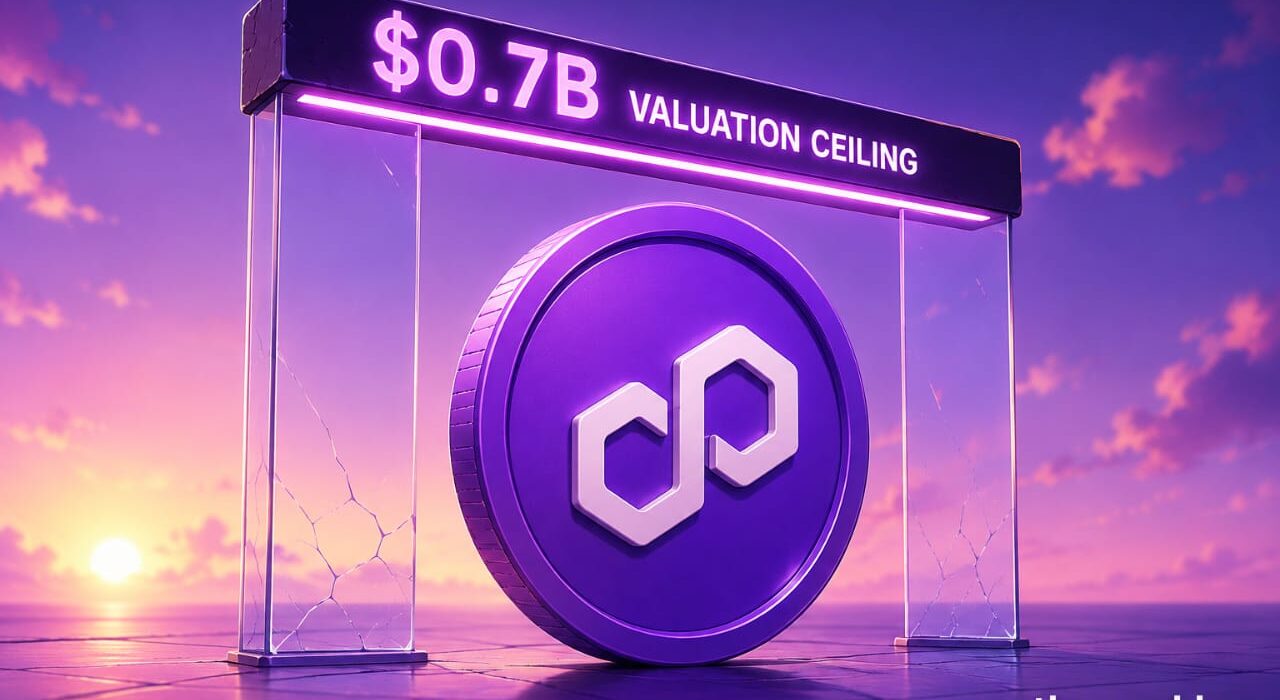
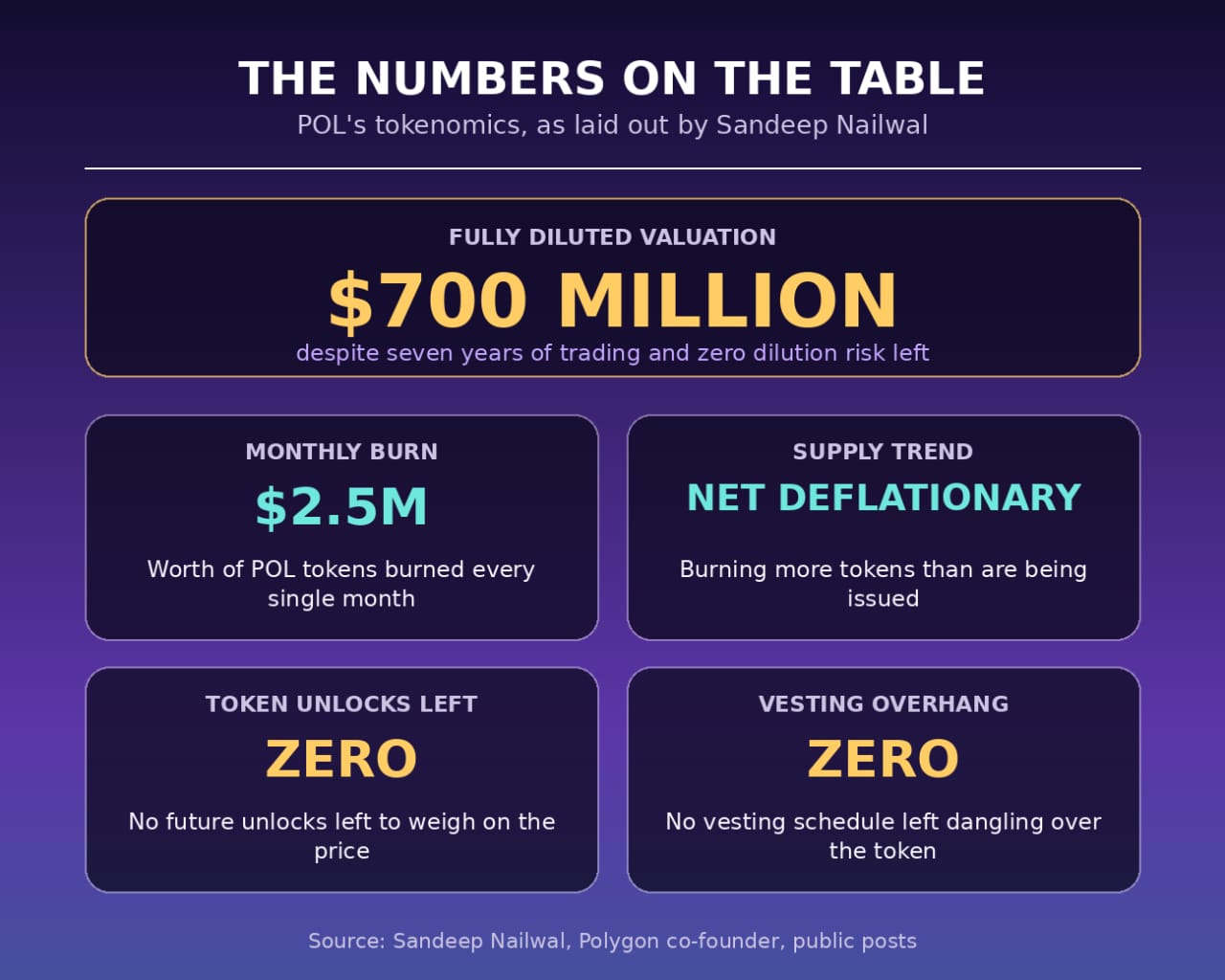
POL is sitting at the center of a genuinely strange puzzle in plain sight: a token that burns more than it issues, has zero unlocks left, zero vesting overhang, and has been trading openly for seven full years, yet still can’t get its fully diluted valuation above $700 million.
Polygon co-founder Sandeep Nailwal put those numbers out there this week, and instead of settling the debate about POL’s tokenomics, he ended up starting a much bigger one about whether crypto Twitter even wants to look at data anymore.
The Numbers Sandeep Put On The Table
Sandeep laid out the core claim plainly: POL burns roughly $2.5 million worth of tokens every single month, and has been running net deflationary, burning more than it issues, for a meaningful stretch of time now.
I think the framing he chose is what made this land the way it did. He wasn’t just citing a burn number in isolation, he was pairing it with everything that should theoretically make a token’s price behave well: no unlocks left to worry about, no vesting schedule dangling overhead, seven years of trading history behind it, and a fully diluted valuation sitting at just $0.7 billion despite all of that. On paper, that’s a genuinely unusual combination. Most tokens with heavy dilution overhangs get a pass for depressed pricing, everyone assumes it’ll recover once unlocks stop. POL doesn’t have that excuse available anymore, and Sandeep seemed to be pointing directly at that gap.
The Community’s Blunt Pushback
The replies didn’t take long to arrive, and they weren’t gentle. One commenter turned the question back on Sandeep and the Polygon team directly, essentially asking why, after all of this, the price still sits this low, and what the team itself might be doing wrong.
Another response pushed the conversation toward a concrete policy question, asking whether Polygon would consider using its own revenue to actively buy back POL and support the price directly, rather than relying purely on the burn mechanism to do that work passively.
I think both of these responses capture something real and fair: burning tokens is a supply-side lever, and if demand simply isn’t showing up to meet that shrinking supply, the burn alone was never going to be enough on its own. That’s not an unreasonable thing to point out, whatever you think of the tone.
Vadim’s Case For Making Burns Protocol-Native
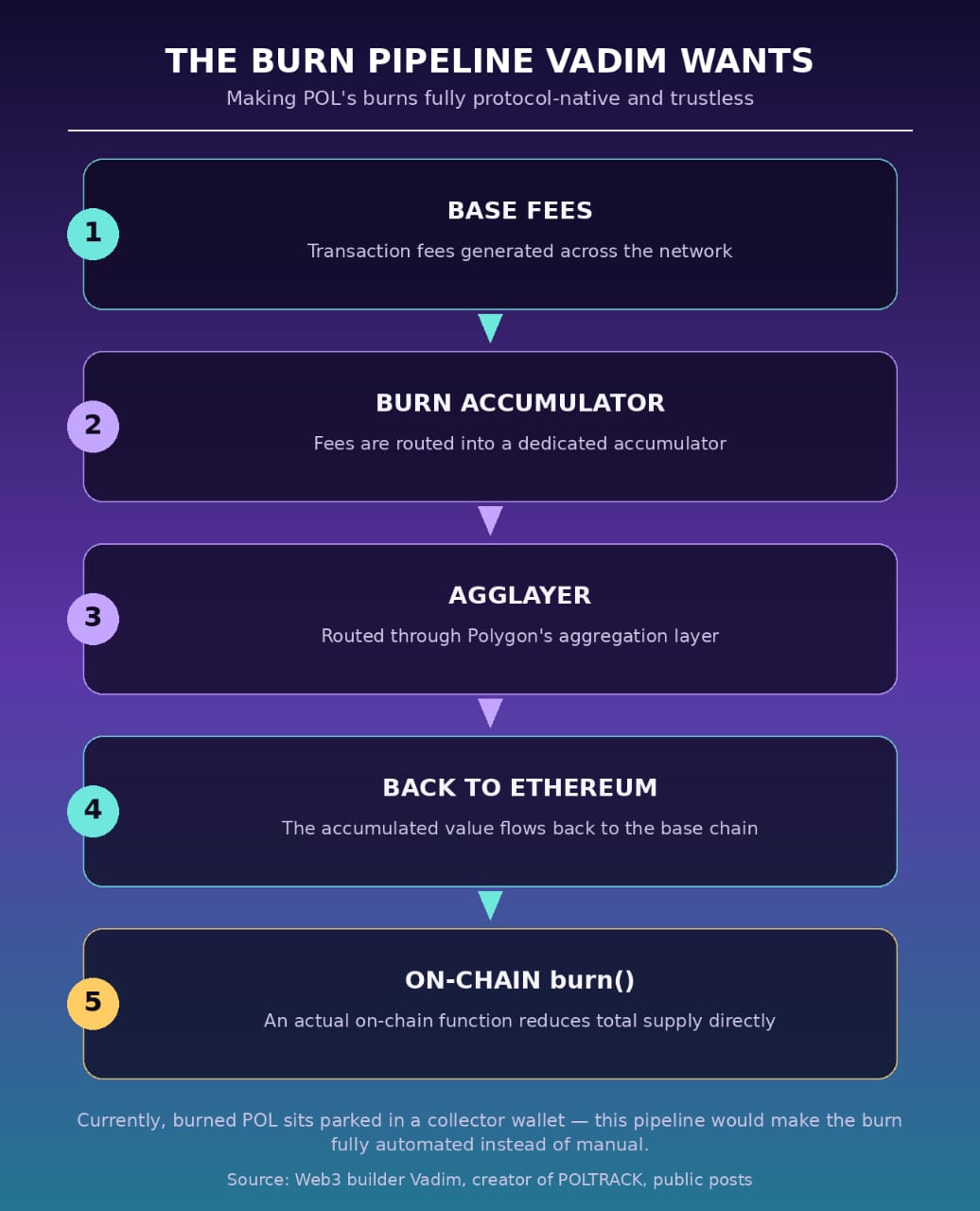
Web3 builder Vadim added a genuinely substantive technical layer to the conversation, one that I think deserves more attention than it got. He said he’s waiting for Polygon to make POL burns fully protocol-native, describing a specific pipeline: base fees flowing into a burn accumulator, then through AggLayer, back to Ethereum, and finally into an actual on-chain burn() function that reduces total supply directly, rather than burned POL simply sitting parked in a collector wallet.
I think this is actually the sharpest point raised in the entire exchange, and it’s easy to miss if you’re just skimming the price complaints. Vadim’s argument isn’t that the burns aren’t real, it’s that the mechanism executing them isn’t fully automated and trustless yet, and he suspects that gets resolved once Polygon’s final chain architecture and AggLayer integration are complete. That’s a meaningfully different critique than “the burn isn’t working.” It’s closer to “the burn is real, but the plumbing delivering it still has a manual step in it that a fully mature system shouldn’t need.”
Why Poltrack Exists In The First Place
What I found most revealing in this whole exchange was Vadim’s own explanation for why he built POLTRACK at all. He said plainly that he got tired of answering the same questions about POL tokenomics over and over, and that people now look at verifiable numbers and simply refuse to believe they’re real. He was direct about the frustration: all the data is verifiable, there’s a public methodology behind it, anyone can cross-check the figures against on-chain data and public analytics platforms, and in 2026, anyone can literally ask an AI to independently verify the numbers themselves. Despite that, he said, a lot of people don’t want to verify anything, because they’ve already made up their minds and only want information that confirms what they already believe.
I think that’s a genuinely uncomfortable observation to sit with, and not just about Polygon specifically. He didn’t mince words about who he thinks is driving that resistance either, saying plainly that some people pushing back are haters, some are just not thinking it through, and some are both, adding pointedly that it’s strange anyone in 2026 still hasn’t figured out how to ask an AI to verify data for themselves.
The Real Debate: Verifiable Data Versus Stubborn Belief
Here’s where I land on this, and I’ll say it plainly: both sides of this argument are making a fair point, they’re just talking past each other. The community’s frustration isn’t really about doubting whether burns are happening, it’s about a legitimate, older complaint in crypto: verifiable fundamentals don’t automatically translate into price appreciation, and demanding that people simply trust the mechanics while the chart stays flat is a real ask, not an unreasonable one. Sandeep and Vadim’s frustration is equally fair from where they’re sitting: if you’ve built a transparent, cross-checkable system and people still respond with suspicion rather than actually running the verification themselves, that’s a genuinely different problem than the tokenomics being weak.
I don’t think this is a case where one side is simply right and the other is simply in denial. It’s two different, entirely legitimate frustrations colliding, one about market behavior not rewarding sound fundamentals fast enough, and one about a community that increasingly treats verifiable, public data as just another unconvincing claim to be dismissed rather than checked.
Where This Leaves Pol Holders
I think the honest takeaway here is that Polygon’s tokenomics argument and Polygon’s price action are, for now, two separate stories running in parallel rather than reinforcing each other the way you’d expect. The burn mechanics genuinely do look strong on the numbers presented, no unlocks, no vesting overhang, sustained net deflation, seven years of price discovery already behind it. Vadim’s proposed fix, moving burns fully on-chain and protocol-native rather than routed through a manual collector step, is a concrete, technically sound suggestion that would genuinely strengthen the credibility of the mechanism further once AggLayer integration matures.
But strong tokenomics on paper clearly hasn’t been sufficient to move price on its own here, and I think that’s the tension worth sitting with rather than resolving too quickly in either direction. Whether that gap eventually closes once the burn becomes fully automated and trustless, as Vadim expects, or whether it points to something deeper about demand simply not existing regardless of supply mechanics, is genuinely the open question this entire exchange leaves unanswered. For anyone holding or watching POL, that’s the actual debate worth tracking, not whether the burn numbers are real, but whether verifiable supply discipline is ever enough on its own to move a market that’s stopped paying attention to it.
Disclosure: This is not trading or investment advice. Always do your research before buying any cryptocurrency or investing in any services.
Follow us on Twitter @themerklehash to stay updated with the latest Crypto, NFT, AI, Cybersecurity, and Metaverse news!